The Forgiveness Cross & Walkway — Memory Mountain, Haasts Bluff NT
Corten Steel Structure · Sandstone Mountain Summit · Remote Central Australia · Indigenous Community Project
Some engineering projects are defined by their technical complexity. Some are defined by where they are built. And some — very rarely — are defined by what they mean to the people who commissioned them.
The Forgiveness Cross on Memory Mountain (Kurrkalnga Puli) is all three.
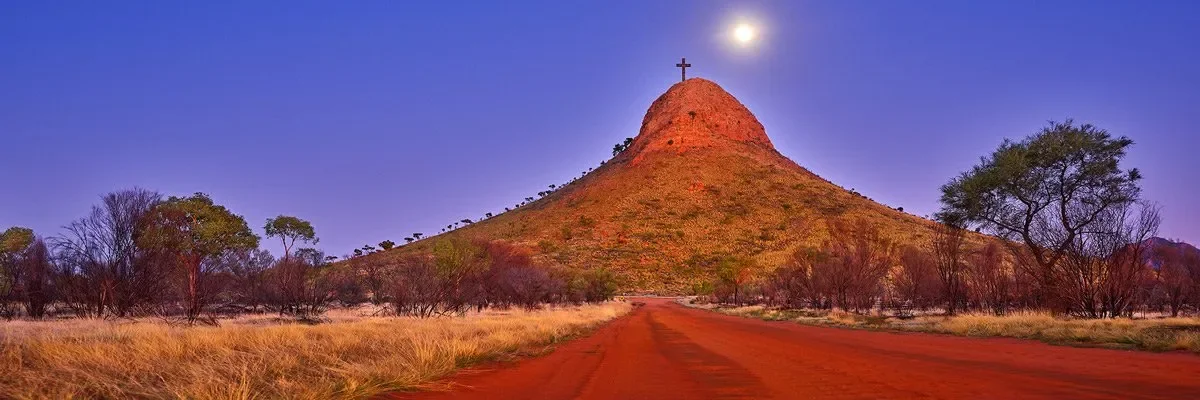
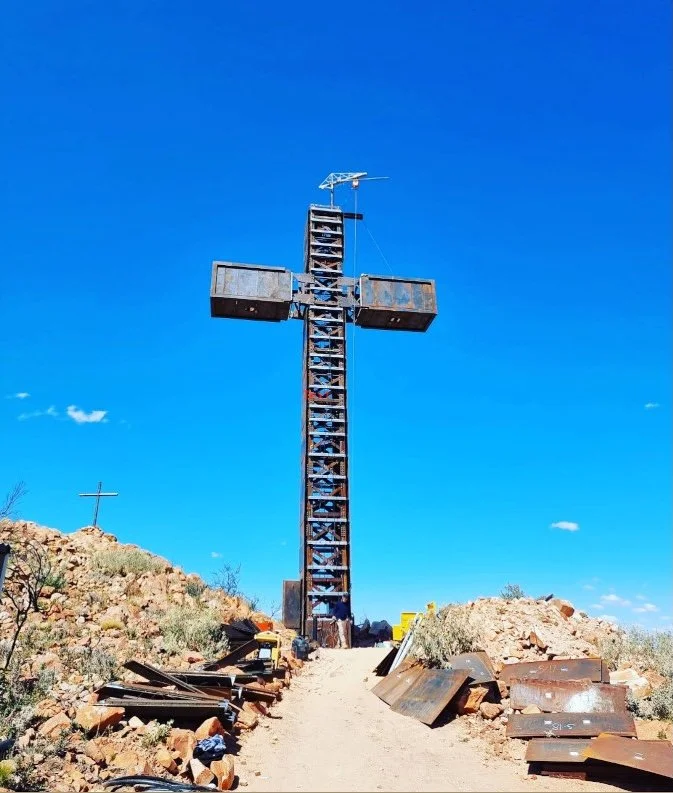
Standing 20 metres tall at the summit of Memory Mountain in Central Australia, 230 kilometres west of Alice Springs, the Forgiveness Cross is a Corten steel structure realising a decades-long vision of the Ikuntji people of Haasts Bluff — the Aboriginal community whose elders dreamed of a great cross on their mountain going back generations. Thitchener Consulting provided the structural engineering for both the cross itself and the steel grate walkway that ascends the mountain to reach it.
It is one of the most remote and logistically demanding structural engineering commissions undertaken by this practice — and one of the most significant.
The Brief & The Site
Memory Mountain rises from the red earth of the West MacDonnell Ranges in the Northern Territory — a sandstone formation of considerable cultural and spiritual significance to the Ikuntji community and surrounding peoples. The vision to place a 20-metre cross at its summit originated with community elders and was championed over more than a decade by renowned Australian landscape photographer Ken Duncan, whose Walk A While Foundation raised the private funding required to make the project possible.
The engineering brief was demanding on every dimension. The structure needed to be visually monumental — 20 metres of steel visible for vast distances across the desert landscape, illuminated at night — while being structurally sound in an environment of extreme temperature variation, high wind exposure, and a foundation substrate of bare sandstone mountain rock. Construction had to be carried out with minimal disturbance to the mountain itself, in ambient temperatures reaching 45 degrees, with a remote Central Australian location presenting supply chain and access challenges that simply do not exist on a coastal NSW building site.
[GRAEME TO CONFIRM: Confirm the year Thitchener Consulting was engaged and the year construction was completed — publicly documented as late 2022 construction with the official opening Easter 2023. Also confirm who the structural client was — Memory Mountain Limited, Ken Duncan's Walk A While Foundation, or the Ikuntji community directly.]
The Forgiveness Cross — Structural Engineering
Material Selection — Corten Steel
Corten weathering steel was the clear choice for the cross structure. In the Central Australian environment — extreme UV, wide diurnal temperature swings, occasional high rainfall events followed by extended dry periods, and the practical impossibility of ongoing maintenance at a remote mountain summit — a painted or coated structural steel would be a liability over the long term. Corten forms its own stable, adherent oxide patina that actively halts further corrosion without maintenance, and its deep red-brown colour tone sits naturally against the red ochre of the landscape and the sandstone of the mountain.
A 20-metre Corten steel cross visible from hundreds of kilometres at night when illuminated is not a small fabrication exercise. The structural design had to account for the self-weight of the steel sections, wind loading at altitude on an exposed mountain summit, the dynamic effects of gusting desert winds on a tall slender structure, and the differential thermal movement inherent in a large steel structure in a climate of extreme temperature range.
[GRAEME TO CONFIRM: Add structural specifics here: steel section sizes used for the vertical and horizontal members, base plate and foundation connection design, how the cross is anchored into the sandstone summit, any temporary works or erection methodology required given the remote access. What were the design wind loads assumed at this location and altitude?]
Foundation into Sandstone Rock
The summit of Memory Mountain is bare sandstone — an advantage in terms of bearing capacity, but a constraint in terms of construction methodology. Rock anchors or drilled and grouted connections into the sandstone provided the base connection for the cross, eliminating the need for concrete foundations that would have been both logistically difficult to deliver to a remote mountain summit and visually intrusive on the natural rock surface.
[GRAEME TO CONFIRM: Confirm the foundation type — rock anchors, drilled piers, cast-in-place base, or another solution. What equipment was used to drill into the sandstone at the summit, and how was it transported to that location? This is a compelling construction story worth telling in detail.]
The Mountain Walkway — Structural Engineering
Steel Grate Walkway, Core-Drilled into the Mountainside
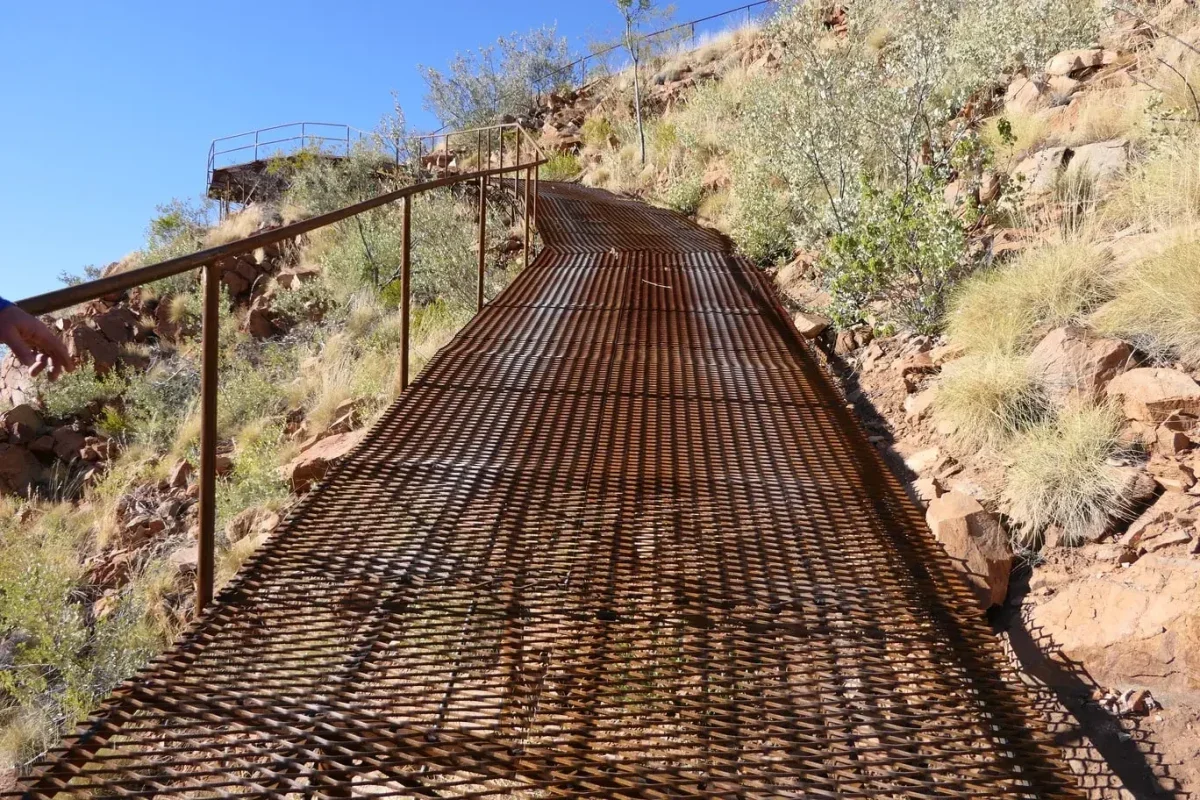
The walkway ascending Memory Mountain to the cross presented a different but equally demanding structural challenge. The path needed to carry pedestrian loading safely on a steep mountain gradient, be durable enough to withstand the Central Australian climate without ongoing maintenance, and cause minimal disturbance to the mountain surface, its native flora, and the cultural integrity of the site.
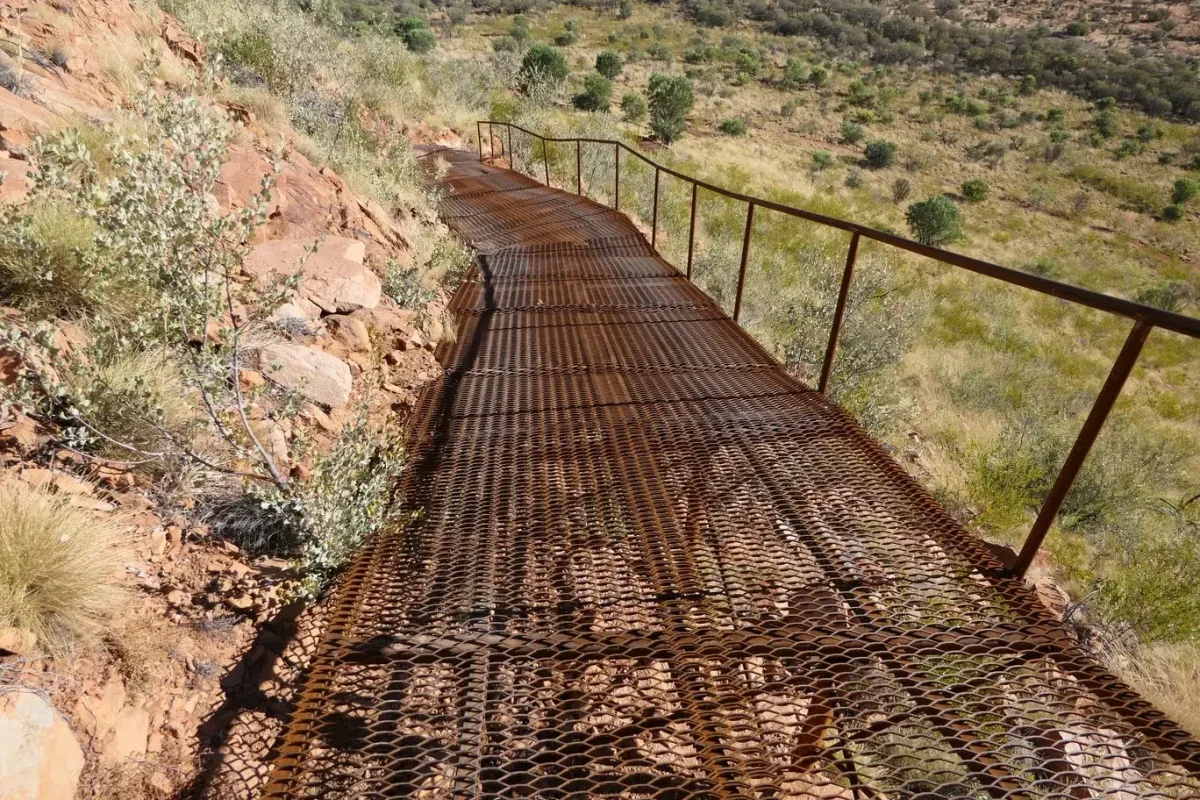
The solution was a steel grate walkway — open mesh panels providing safe footing and natural drainage — supported on steel poles core-drilled directly into the sandstone mountainside. Core-drilling into living rock eliminates the need for concrete footings along the walkway route, preserving the mountain surface and avoiding excavation that would damage both the rock and any vegetation. Each pole is drilled, cleaned, and grouted or mechanically fixed into the sandstone, with the grate panels spanning between poles at a geometry that follows the natural line of the mountain rather than cutting across it.
[GRAEME TO CONFIRM: Add structural specifics for the walkway: pole diameter and section, spacing between poles, grate panel specification, connection detail between pole and grate, how the pole hole diameter and depth were determined for the sandstone bearing conditions encountered. What was the design live load for the walkway — pedestrian crowd loading or single-file pedestrian? Were there any sections requiring handrails or edge protection that presented additional structural fixing challenges into the rock face?]
Designing for Minimal Disturbance
The walkway structural design was governed as much by what it should not do as by what it needed to achieve structurally. The Ikuntji community and the project team were clear that the mountain itself — its rock, its vegetation, its landform — was not to be compromised by the infrastructure built upon it. Every structural decision, from pole spacing to grate panel size to the method of fixing, was made with that constraint in mind.
Working within that constraint while maintaining structural adequacy for public access — including the WH&S compliance requirements that govern a publicly accessible walkway — required careful coordination between the structural design and the construction methodology on site. Remote location meant that errors in specification could not be easily rectified; the structural documentation had to be complete and unambiguous before construction commenced.
[GRAEME TO CONFIRM: Were there any specific NT or federal regulatory requirements that applied to the walkway as a publicly accessible structure on Aboriginal land? Any heritage or land management body approvals that affected the structural approach?]
Construction in Remote Central Australia
The practical challenges of building in this location are worth noting plainly. Haasts Bluff is 230 kilometres west of Alice Springs on an unsealed road. There is no local supply chain for structural steel, no local fabrication capacity, and no local construction workforce with steel erection experience. Everything — materials, equipment, expertise — had to travel to site.
Construction of the cross itself was carried out in temperatures reaching 45 degrees. Community members from Haasts Bluff worked alongside the construction team to erect the steel, contributing directly to a project that was theirs by vision and by right. That the structure was completed and standing — a 20-metre Corten steel cross visible across the Central Australian desert — is a testament to everyone involved, including the structural engineering that made it buildable in those conditions.
[GRAEME TO CONFIRM: Add any detail about the construction process from your perspective as the structural engineer — how the documentation was prepared for remote construction, whether you visited the site during construction or at completion, and any particular challenges in the structural specification that the remote location required you to resolve differently than you would for a metropolitan project.]
Significance
The Forgiveness Cross was officially opened at Easter 2023, marking exactly 100 years since four young Ikuntji missionaries first carried the gospel to the western desert communities. The cross was the culmination of a vision held by community elders for generations — a dream that outlasted the individuals who first dreamed it and was realised by their descendants.
From a structural engineering perspective, this project sits outside the normal parameters of practice: extreme remoteness, extreme climate, a foundation substrate of bare mountain rock, a structure of cultural and spiritual significance to an entire community, and a construction environment that demanded as much logistical problem-solving as technical engineering. It is the kind of project that tests the full depth of an engineering practice — and remains, for Thitchener Consulting, among the most meaningful work undertaken in 45 years of practice.
Project Collaborators & Credits
Client: Ikuntji Community / Memory Mountain Limited
Project Champion & Funder: Ken Duncan — Walk A While Foundation (walkawhile.org.au)
Photography: Ken Duncan (kenduncan.com) — subject to permission for website use
[GRAEME TO CONFIRM: Confirm the correct client entity to credit. Also confirm whether Ken Duncan has given permission for his photography to be used on the Thitchener Consulting website — given his personal connection to the project and community, a direct approach through Graeme's existing relationship is the right path. If permission is granted, his name and website should be credited alongside each image used. If not, your own site progress photographs of the walkway are the primary imagery for this page.]
The Forgiveness Cross has become a place of pilgrimage and cultural tourism for people travelling to Central Australia, bringing employment and economic activity to the Ikuntji community. Memory Mountain is now accessible as part of guided tours operated by the community through Memory Mountain Limited.
Location: Memory Mountain (Kurrkalnga Puli), Haasts Bluff (Ikuntji), Northern Territory — 230km west of Alice Springs
Completed: Late 2022 (officially opened Easter 2023)
Structural engineer: Thitchener Consulting